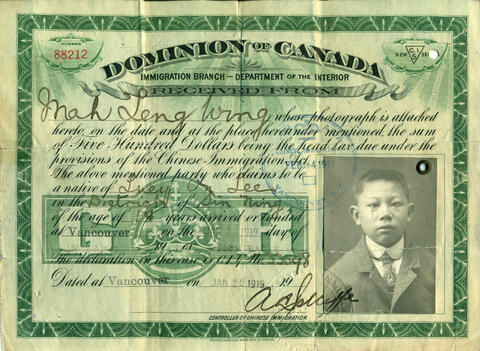
Many families of third- or fourth-generation overseas Chinese have a drawer or folder somewhere in the house, stuffed with yellowed papers. A card with a photograph. A form stamped by a government office. A document with a Chinese name written in brush ink beside a strange English registration number. Decades pass, family members flip through them and put them back, and no one can quite explain what they are or why they matter.
On December 15, 2025, that changed.
Canada’s Bill C-3 came into force. This legislation removed the so-called “first-generation limit” from the Citizenship Act, allowing descendants of further generations to trace their lineage and apply directly for a Proof of Citizenship — without first immigrating to Canada or obtaining permanent residence.
This article is a practical self-check guide: what documents your family might have, which ones are legally useful, which are only clues, and where to search for them.
A Historical Fact You Must Understand First
Before diving into the document checklist, one critical misconception must be addressed — otherwise your entire search may go in the wrong direction from the start.
Bill C-3 requires that you have a Canadian citizen ancestor.
But here is the historical paradox: before 1947, the legal concept of “Canadian citizen” did not exist. The Canadian Citizenship Act came into force for the first time in 1947. Before that, Canada only recognized the status of “British subject” — there was no separate Canadian citizenship.
So who automatically became the first Canadian citizens in 1947?
The answer: people born on Canadian soil. Under the principle of jus soli (birthright citizenship), anyone born in Canada held British subject status, and when the Citizenship Act took effect in 1947, those individuals automatically became Canadian citizens.
This matters enormously because it defines the starting point of any Bill C-3 claim:
The question is not whether your ancestor lived in Canada — it is whether your ancestor was born on Canadian soil.
Most Chinese labourers who came to Canada in the late 19th and early 20th centuries to work in mines or build the railway were born in China. They themselves do not qualify. But some of them had children while living in Canada — children born on Canadian soil. Those children are the “Canadian citizen ancestors” that Bill C-3 is built around.
So “my great-grandfather helped build the CPR” and “I qualify under Bill C-3” are separated by a clear threshold: you need to find the generation that was actually born in Canada.
Document Type 1: Core Evidence — The C.I.44 Registration Card
What It Is
In 1923, Canada passed the Chinese Immigration Act, effectively barring Chinese immigration. Starting in 1923–1924, the government required all Chinese persons in Canada — whether immigrants or Canadian-born — to register with a local immigration officer and receive an official identity document. This was the C.I.44 form.
What It Looks Like
The C.I.44 is a registration card with a photograph, recording the holder’s Chinese name, English transliteration, age, place of birth, Canadian residence, and a registration number. If your family has an old card with a photo and an official stamp, there is a good chance it is a C.I.44.
Why This Document Matters Most
The C.I.44 contains a critical field: native-born.
If your ancestor’s C.I.44 is marked “native-born,” this directly proves that person was born in Canada, forming a complete legal chain:
native-born notation → born in Canada (jus soli) → automatically became a Canadian citizen in 1947 → you, as a descendant, may apply for Proof of Citizenship under Bill C-3
Where to Search
Library and Archives Canada (LAC) has digitized a large collection of C.I.44 records, searchable online at: LAC Collection Search Database
Search your ancestor’s name (try both the Chinese romanization and various English transliterations). You can also filter by the archival series “Chinese Immigration Act, 1923 — C.I. Forms.”
Important: Finding “native-born” is not the end of the process
The native-born notation establishes the starting point of the bloodline. But IRCC also needs to verify the generational chain connecting you to that ancestor — each generation requires civil registration documents: birth certificates, marriage certificates, and so on, all the way up to you.
Document Type 2: Clue Evidence — Head Tax Receipts, CI Series Certificates, and Chinese General Registers
This category includes: Chinese labourer registration certificates (CI 5, CI 6, CI 28, CI 30 series), head tax receipts (issued at $50, $100, and $500 at different historical stages), and entries in the 18-volume Chinese General Registers (1885–1949) held by LAC.
What these documents prove: They confirm that an ancestor lived in Canada and paid taxes — but they do not prove Canadian birth and are not direct evidence for a Bill C-3 application. Their correct use is to establish your ancestor’s timeline and location in Canada, then investigate whether any of their children were born on Canadian soil.
All searchable through the LAC Collection Search Database.
Document Type 3: Chain Evidence — Birth, Marriage, and Death Certificates
These are the civil registration documents connecting you to your Canadian citizen ancestor, one generation at a time. IRCC typically requires: your own birth certificate, your parents’ birth and marriage certificates, your grandparents’ documents, and so on, up to the generation with the Canadian-born ancestor.
The application requires Form CIT 0001 (Proof of Citizenship Application) and Document Checklist CIT 0014.
What to Do When Documents Are Missing: Four Search Paths
Path 1: Library and Archives Canada (primary source)
LAC Collection Search Database — C.I.44 records, all 18 volumes of Chinese General Registers, CI series certificates, and head tax receipts are all searchable here.
Path 2: Newfoundland — Newfoundland joined Confederation in 1949. Its pre-Confederation records are held at The Rooms Provincial Archives in St. John’s, not at LAC.
Path 3: BC Vital Statistics — BC Vital Statistics Agency holds records from 1872 onward. Some records are also accessible through Ancestry.ca.
Path 4: Archives in China — Many early Chinese Canadians came from Taishan, Kaiping, and Xinhui in Guangdong Province. The Guangdong Provincial Archives and local county gazetteers may hold relevant records.
Application Framework
- Main application form: Form CIT 0001 (Proof of Citizenship Application)
- Document checklist: CIT 0014
- Application fee: CA$75 (confirm current fee at canada.ca)
- Mailing address: 300 Slater Street, 12th Floor, Ottawa, ON K1A 1L1 (please verify current address)
- Processing time: dynamic — check the IRCC website for current timelines
Four Common Misconceptions
Misconception 1: “My ancestor paid the head tax, so I qualify.” — Incorrect. Head tax receipts prove entry into Canada, not birth in Canada.
Misconception 2: “My ancestor lived in Canada for many years, so I qualify.” — Incorrect. The key factor is place of birth, not length of residence.
Misconception 3: “I found a C.I.44, so I’m done.” — Not yet. You still need a complete generational chain of civil registration documents.
Misconception 4: “Documents are lost, so there is no chance.” — Not necessarily. The LAC database, alternative evidence, and family genealogies are all worth exploring.
Conclusion
The correct self-check sequence: start with C.I.44 (look for the native-born field) → use clue evidence to trace back and identify the right generation → compile chain documents confirming each generation has corresponding civil registration records.
The Bill C-3 application window is open. If your family has a history of Chinese Canadian immigration, a preliminary self-check using these three document types is worth your time.
If you have questions, please contact us to schedule a free consultation.
Disclaimer
This article is written by a Registered Canadian Immigration Consultant (RCIC) for educational purposes only and does not constitute legal or immigration advice. Policy information is current as of December 2025; dynamic data (processing times, fees) should be verified at the IRCC website. Every applicant’s situation is different and individual eligibility must be assessed on a case-by-case basis.